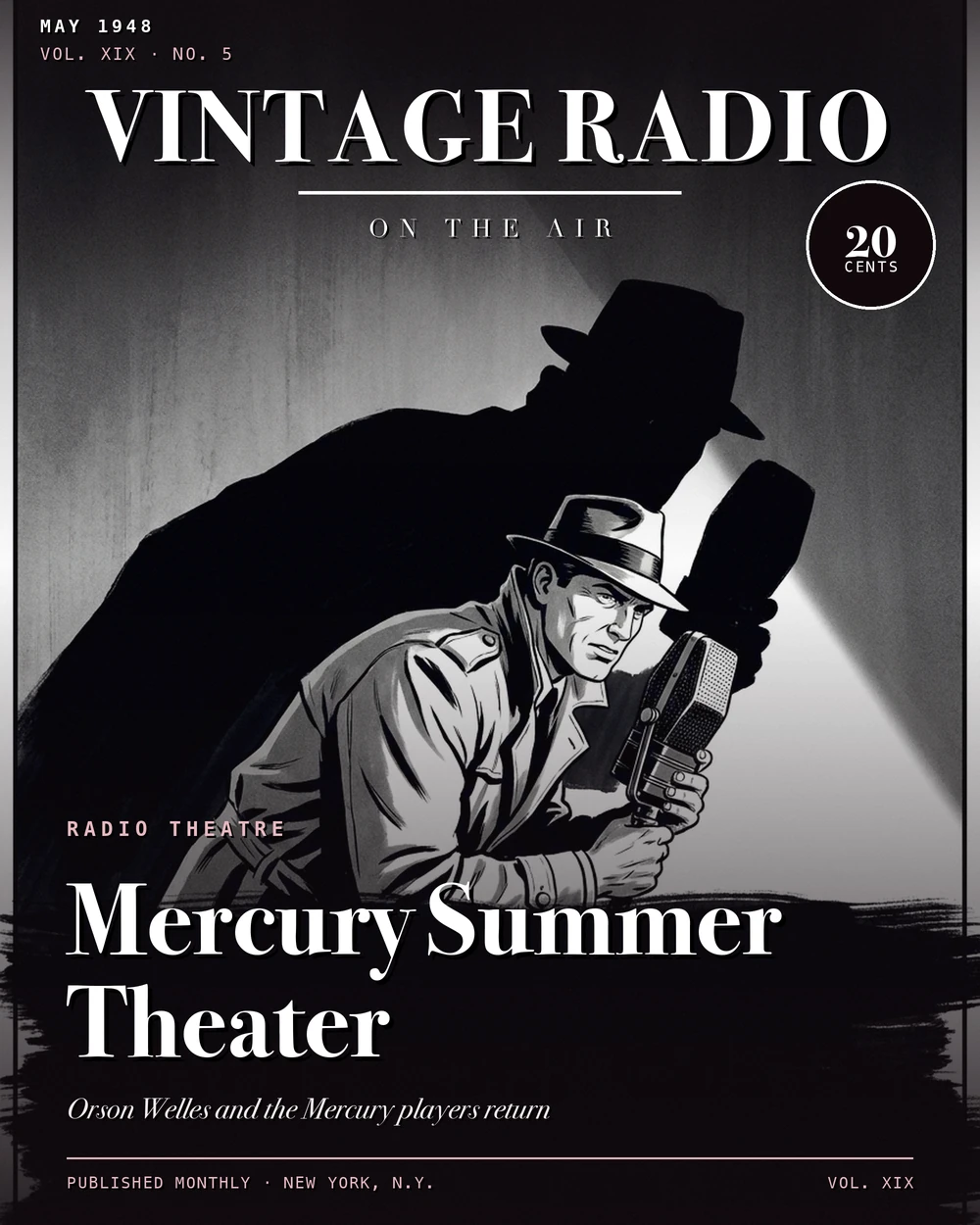
Mercury Summer Theater
A Reunion That Almost Didn't Happen
By the summer of 1946, the Mercury Theatre company that Orson Welles and producer John Houseman had founded in New York City in 1937 had technically been gone for four years. Welles had been fired from RKO in 1942, and the troupe formally disbanded around that time. So when CBS brought Welles back to radio that June, sponsored by Pabst Blue Ribbon beer for a Friday-evening slot at 10 p.m. Eastern, it wasn't just a new anthology drama — it was something closer to a company reunion.
The timing was complicated, to put it mildly. Welles was simultaneously mounting a Broadway stage production of Around the World in 80 Days, which had opened May 31, 1946, just a week before the radio series premiered. That stage show ran for 75 performances and then closed. Through all of it, Welles was producing, directing, and performing on Mercury Summer Theater — a workload that says a great deal about both his ambition and his inability to do just one thing at a time.
The series ran fourteen episodes, from June 7 through September 13, 1946. It was not renewed for another season, having had limited commercial success. And in the fall of 1947, Welles left for Europe and never mounted another American radio drama series. That makes Mercury Summer Theater, by any measure, the end of something.
The Company Behind It
One of the things that makes this series worth understanding on its own terms is who came back for it. Richard Wilson, the Mercury Theatre's director of rehearsals, returned in the same role. Bernard Herrmann — who had been Welles' music director since the original Mercury Theatre on the Air launched in 1938 — served as music director and conductor again here. That Welles-Herrmann collaboration, which would eventually extend to Citizen Kane and The Magnificent Ambersons on the film side, is one of the defining creative partnerships in American radio, and this 1946 series was its last chapter in that medium.
The acting roster was deep. Joseph Cotten and Agnes Moorehead, the two Mercury veterans most associated with the company's best-known work, both appeared. Beyond them, the extended cast included George Coulouris, Ray Collins, Edgar Barrier, Hans Conried, Frank Readick, Arthur Anderson, Dan Seymour, Karl Swenson, Eustace Wyatt, and Bud Collyer, drawn from former Mercury ranks or the New York radio talent pool. Welles himself performed key roles throughout and narrated when the material called for it. The 30-minute format was tighter than the 60-minute programs the original Mercury Theatre on the Air had produced, but the production values held.
The Material They Chose
The series was an anthology drama, mixing abridged versions of scripts the Mercury company had already staged or broadcast with new productions built specifically for this run. Classic literature, stage plays, and original works all made the cut.
The premiere on June 7 was an adaptation of Around the World in 80 Days — the same material Welles was staging on Broadway that season — featuring music by Cole Porter and the original Broadway cast. It is described as the only known recording from that stage production, which gives it a documentary value entirely separate from its entertainment merits.
Writer Norman Corwin contributed at least two scripts to the run. His adaptation of Jane Eyre, broadcast June 28, starred Welles alongside Alice Frost. His original piece "The Moat Farm Murder," which aired July 26, paired Welles with Mercedes McCambridge. Lucille Fletcher, whose radio work had already established her as one of the form's sharper talents, wrote "Search for Henry Le Ferre" — an original story composed specifically for the series, not an adaptation — which aired July 12.
The Moby Dick episode, broadcast August 30, featured a substantial supporting cast: William Alland, Byron Kane, John Brown, Earle Ross, and Elliott Reid alongside Welles. The final broadcast, on September 13, was a production of scenes from King Lear, with Agnes Moorehead, William Alland, and Edgar Barrier rounding out the cast. Closing on King Lear feels, in retrospect, like a conscious gesture toward something — though whether that was Welles' intention or simply good scheduling is hard to say.
Where It Fits in the Mercury Story
The Mercury Theatre on the Air — the original 1938 CBS series that preceded this one — was inducted into the National Radio Hall of Fame in 1988. That series ended when Campbell's Soup came on as sponsor following the War of the Worlds broadcast in October 1938, at which point it became the Campbell Playhouse, which ran from December 1938 until 1940. Mercury Summer Theater in 1946 is the third and final chapter of that lineage.
It's worth being precise about where this series sits relative to other drama anthologies of the era. Lux Radio Theatre, which the original Mercury Theatre on the Air had actually served as a summer replacement for back in 1938, predates all of this work — Lux launched in 1934. Mercury Summer Theater was not a predecessor to Lux; if anything, the relationship ran the other direction. The series does share a tradition with programs like Academy Award Theater and Campbell Playhouse, all of which built their runs around adaptations of established literary and theatrical material, but Mercury Summer Theater occupied the tail end of that wave rather than leading it.
The series' sound design and integration of theatrical elements were consistent with the Mercury company's earlier radio work — careful, production-conscious radio that treated the audio environment as something to be composed rather than just assembled. Herrmann's continued involvement as music director ensured that the scoring stayed in keeping with what the company had built its reputation on.
Fourteen episodes over a little less than four months isn't a long run. But in that span the series pulled together writers like Corwin and Fletcher, actors of the caliber of Moorehead, Cotten, McCambridge, and Coulouris, and a production infrastructure that most radio drama programs of the era couldn't have matched. It didn't find a big enough commercial audience to continue, and Welles was gone from American radio entirely not long after. What the series left behind is a compressed, final document of what the Mercury company could do when it had the chance to work together one more time.